CBN vs Melatonin for Sleep: Which One Actually Keeps You Asleep?
Medically reviewed for accuracy by Dr. Bruce Rubinowicz, Board-Certified Neurologist & Sleep Medicine Specialist
Quick Answer
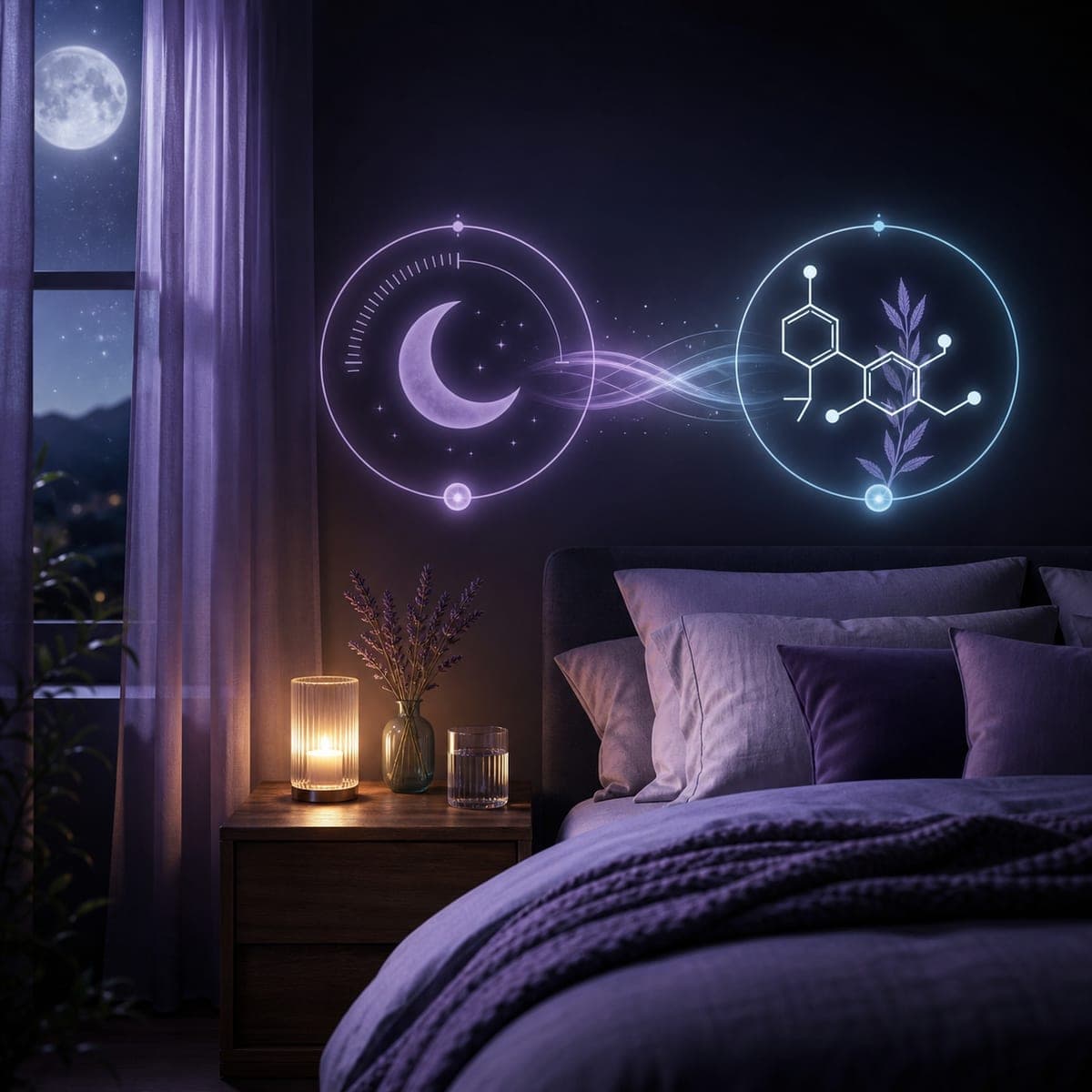
Melatonin is a timing signal best for jet lag and a shifted schedule; CBN is a sedative-leaning cannabinoid people reach for to stay asleep. Match the tool to your problem: timing or maintenance.
Picture the person who falls asleep without a fight. Lights out at eleven, gone by eleven-fifteen, no trouble at all. Then 3 a.m. arrives and so does she, eyes open, heart a little fast, mind already running an inventory of every regret going back two decades. She is not someone who struggles to fall asleep. She struggles to stay asleep. And the supplement aisle, for the most part, was not built for her.
A lot of people in her situation have been reaching for melatonin for years, getting nothing, and assuming the problem is them. It usually isn't. They are using a timing tool to fix a maintenance problem. Melatonin and CBN both get filed under "sleep," but they answer two different complaints, and once you see which complaint is yours, the choice gets a lot simpler.
Melatonin is a clock, not a sedative
This is the part most people have backwards. Melatonin isn't a knockout drug. It's a signal.
Your body releases it as ambient light fades, and that rising level is how the rest of your system learns that night has arrived and the machinery of sleep can start spooling up. A dimmer switch labeled "it is now nighttime," more than a sledgehammer. That sounds modest, but it's exactly why melatonin is genuinely good at one specific job: fixing problems of timing rather than problems of depth. The evidence fits that modest framing; a 2017 systematic review in Sleep Medicine Reviews (Auld and colleagues) found its most convincing benefit was in shortening how long people take to fall asleep, not in deepening sleep itself.
Where it earns its place is circadian disruption. Jet lag is the obvious case. Rotating onto night shifts is another. When your internal clock is pointed at the wrong hour, a small, well-timed dose can coax it back toward the local night, and for that narrow purpose melatonin sits among the few supplements with a reasonable evidence base behind it. A 2002 Cochrane review by Herxheimer and Petrie concluded that melatonin, taken near the destination bedtime, can reduce jet lag after flights crossing several time zones. If your only trouble is convincing your body that bedtime has actually arrived, melatonin may be the whole answer, and there's no shame in stopping here and trying it.
The limitation is what frustrates everyone. Melatonin helps set the start of the night, then clears your system fairly fast. It does not stand guard over the second half. A 2005 meta-analysis in the same journal (Brzezinski and colleagues) put the average reduction in time-to-fall-asleep at only a few minutes, which is real but modest, and says nothing about holding the back half of the night. So the 3 a.m. waker gets very little from it, and sometimes ends up worse off. The usual instinct is to take more, on the theory that more must do more. That's where the morning grogginess comes from, and the strange, almost cinematic dreams. Tellingly, a 1996 study in the journal Sleep (Zhdanova and colleagues) found that low, near-physiologic doses were enough to ease sleep onset without next-morning hangover effects, which suggests the heavy doses packed into a lot of commercial gummies are doing more to fog your morning than to help your night. The amount in those products dwarfs the trace your own body would ever release on its own. The deeper physiology of why these middle-of-the-night wakings happen is its own subject, and it's worth understanding before you blame the bottle. There's a full walk-through in why you wake up at 3 a.m.
So what is CBN doing instead?
CBN, short for cannabinol, is a minor cannabinoid that forms as THC ages and oxidizes. It has nothing to do with the melatonin system. It works through the endocannabinoid system, a regulatory network that touches mood, pain, appetite, and sleep among other things.
That difference is the whole reason these two compounds belong in separate categories. Melatonin tells your system what time it is. CBN leans toward calming the body once you're already in bed. Comparing them directly is a bit like comparing a thermostat to a blanket. The deeper story of that signaling network and how it relates to deep sleep is laid out in this piece on the endocannabinoid system, and it's the missing context for why a cannabinoid would touch sleep at all.
CBN carries a reputation, mostly anecdotal and partly historical, as the sleepy one. Old, degraded cannabis was long rumored to be more sedating, and CBN got the credit for it. In practice, many users report that it helps them stay under rather than simply get under, which is precisely the opposite of melatonin's strength. That maintenance angle is why it keeps coming up for the people who wake at three.
Here's the honesty the topic demands, though. The clinical evidence for CBN as a standalone sleep aid is early. A 2021 review in Cannabis and Cannabinoid Research (Corroon) went looking for human data and found it dated and thin, concluding there isn't yet enough rigorous evidence to confirm CBN has the sedative effect its marketing implies. We don't yet have the large, long-term human trials that would let anyone name a precise dose with real confidence, and a fair amount of what gets marketed as CBN-for-sleep rests on extrapolation and user reports more than rigorous data. The most directly relevant trial to date, a 2024 placebo-controlled study in Experimental and Clinical Psychopharmacology (Bonn-Miller and colleagues), is genuinely encouraging on exactly the point that matters here: 20mg of CBN nightly was linked to fewer awakenings and less overall sleep disturbance, while showing no effect on how fast people fell asleep. That is the maintenance-not-timing pattern in miniature, but it is one short study, and the mechanism is plausible while the early signals are interesting. Enthusiasm isn't proof, and it would be a disservice to dress it up as one.
Which one matches the night you're actually having
This is the question that decides everything, so be concrete about your own pattern.
If you fall asleep slowly, lie there for an hour, and your schedule is shifted or chaotic, that's a timing problem. Melatonin is the rational first experiment. Start lower than the bottle suggests, much lower, and take it a couple of hours before the bedtime you're aiming for rather than at lights-out.
If you fall asleep easily but can't hold the night together, the sedation-leaning, endocannabinoid route is the more logical thing to explore. There's a quieter argument worth naming here too. Piling more melatonin onto a body whose own clock is working fine can muddy a signal that didn't need muddying. A compound that never touches the melatonin pathway leaves your natural rhythm alone, which is part of why some formulators deliberately leave melatonin out of their products.
Before spending a dime on either, look at the room and the routine, because the most common cause of fractured sleep isn't a missing molecule. A bedroom that runs too warm will wake you no matter what you swallow; the specifics are in bedroom temperature and sleep. Light at the wrong hours bends your melatonin curve on its own, covered in this guide to circadian lighting. Supplements do their best work as a small lever on top of a setup that's already sane.
Holding the two side by side
It helps to weigh them honestly instead of rooting for a winner.
| Factor | Melatonin | CBN |
|---|---|---|
| What it is | A hormone that signals timing | A sedation-leaning minor cannabinoid |
| Best for | Jet lag, shift work, a clock that runs late | Staying asleep through the back half of the night |
| Onset vs maintenance | Helps you fall asleep on time, then clears fast | Aimed at maintenance more than onset |
| Morning grogginess | Common at the high doses in many gummies | Users report less, though the evidence is early |
| Evidence base | Reasonable for circadian timing | Early and incomplete; one 20mg trial is encouraging |
For a real share of people, melatonin is simply the correct answer, and no CBN marketing wave should talk a jet-lagged traveler out of the one supplement that fits the situation. For another group, the ones with no timing problem at all who just can't stay down, melatonin is solving a problem they don't have. Something gentler on the natural clock makes more sense there.
That second group is the one we had in mind building the Risachi's melatonin-free CBN and CBG sleep gummies. It sits on the maintenance side of this conversation rather than the timing side: each gummy carries 20mg CBN and 15mg CBG, paired with 500mg of Montmorency tart cherry as a concentrated 10:1 extract, and it's third-party tested. It contains no melatonin, deliberately, so it can work alongside your own circadian rhythm instead of overriding it. CBG, the second cannabinoid in the mix, has its own emerging story, and it's even less studied for sleep than CBN, which is all the more reason to treat any claim about it with measured skepticism. It isn't the best anything; it's one transparent, honestly dosed option among real alternatives. If your problem turns out to be timing rather than maintenance, a simple low-dose melatonin might serve you better and cost less. Fair is fair.
A few caveats before you experiment
No supplement substitutes for figuring out why your sleep broke in the first place. Persistent insomnia, loud snoring with gasping, or a months-long run of fragmented nights deserves a real clinical workup, not another gummy. If you take prescription medications, especially anything sedating, blood-thinning, or heavily processed by the liver, talk to a physician or pharmacist before adding either melatonin or a cannabinoid; the interactions are real and worth respecting. Please consult a clinician before combining any of this with existing medications, or for sleep trouble that simply won't let go.
The unglamorous truth is that most people sleep better once they treat the molecule as the last adjustment rather than the first. Get the light and the temperature right. Give your nervous system room to downshift. Then, if you still need a nudge, pick the compound that matches your real complaint, timing or maintenance. That single distinction will steer you better than anything printed on the front of a bottle.
Sources
Frequently Asked Questions
Is CBN or melatonin better for staying asleep?
Melatonin mainly helps you fall asleep on time, then clears quickly, so it does little for middle-of-the-night waking. CBN is more often used for sleep maintenance. If your problem is staying asleep rather than timing, CBN is the more logical thing to try.
Can you take CBN and melatonin together?
Some products combine them, but they solve different problems and stacking is not automatically better. Adding melatonin to a body whose clock is already on schedule can muddy a signal that did not need changing. Talk to a clinician before combining supplements, especially with other medications.
Does CBN make you groggy in the morning?
Many users report less next-morning grogginess with CBN than with higher doses of melatonin, but the research is early and individual responses vary. Start low and see how you feel.
Is CBN the same as CBD?
No. CBN (cannabinol) leans sedative and is associated with sleep; CBD (cannabidiol) is broadly calming and works more indirectly. They are different cannabinoids with different roles.

From Risachi
Sleep Collection Gummies
20mg CBN + 15mg CBG + 500mg Montmorency tart cherry per serving. Melatonin-free.
- Melatonin-free — no morning fog
- Third-party lab tested, COA published
- Vegan, non-habit forming
$39.9924 Gummies per bottle
60-day money-back guarantee · Bundle savings available